
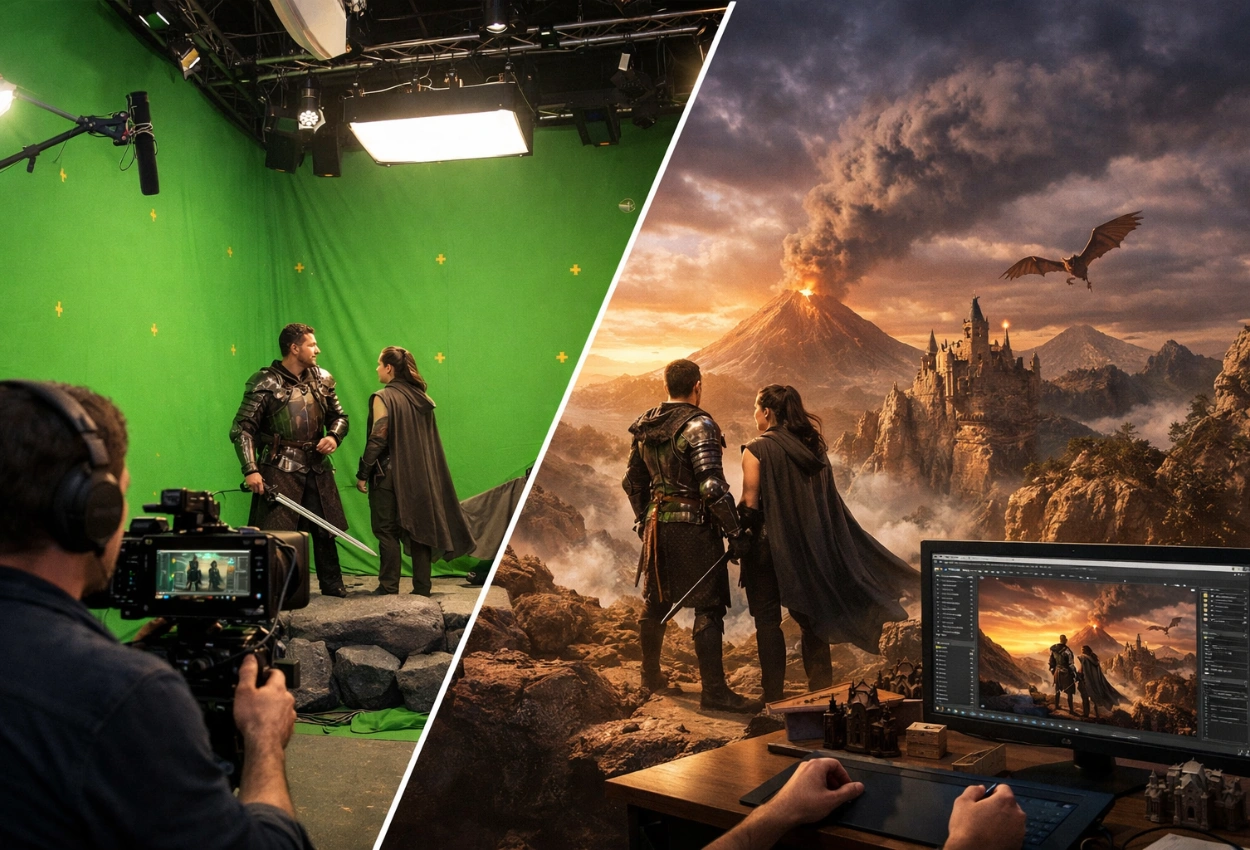
From Green Screen to Final Frame: How VFX Studios Create Movie Magic
A movie engages the audience with its breathtaking worlds, stunts, aesthetic frames, and emotional moments. It takes a whole lot of process to reach their goal, which starts with pre-production, shooting in a live location, and in front of a green screen, and ends with the post-production to create the cinematic frame with the magic of editing and VFX Studio.
It is a collaboration between filmmakers and visual effects companies, Motion Effects, to create unforgettable visual moments.
VFX Studio And Its Magic Process
1. The Journey Begins on a Green Screen Stage
Often, the adventure begins in a vacant studio covered in green cloth. While cameras record performances intended to be altered later, actors act out scenes with few physical components.
While green screen shooting allows filmmakers more creative freedom, it also puts the onus on the visual effects company to either create new worlds or recreate reality in post-production. Accuracy is important at this point. To guarantee smooth integration in the future, camera data, lens information, lighting references, and motion tracking markers are all recorded.
2. Removing the Green
Visual effects studios start the technical process of chroma keying, separating actors from the green background, as soon as footage enters the pipeline. After eliminating the green screen, VFX artists refine edges frame by frame using Rotoscoping for complex movement, Spill suppression to eliminate green reflections, and Matte refinement for hair, fabric, and motion blur.
3. CGI and Environment Design
It is an important process in VFX to develop depth in the scene by constructing the actors’ surroundings, like landscapes, cityscapes, skies, and interiors. To make it more realistic, VFX Studio ensures that shadows fall correctly in the required places.
4. Motion Tracking and Match Moving
Every camera movement on the screen is digitally replicated to give the scene a realistic feel. VFX artists monitor the camera’s movement to ensure that CGI elements move in perfect sync with live-action footage.
5. Simulation and Effects
Visual effects studios use sophisticated simulations to incorporate natural elements like smoke, fire, rain, snow, fog, dust, debris, and atmospheric particles to enhance realism. These simulations work according to the laws of physics for movement, gravity, and lighting to provide a virtually created reality.
6. Compositing
In this process, live-action video, computer-generated imagery, simulations, and background components are all combined into a single frame. A VFX company carefully balances color tones, contrast, light direction, intensity, depth of field, reflections, etc. The objective of this process is that the audience should never notice the effect.
7. Color, Continuity, and Cinematic Finish
The most important aspect to enhance the visual aesthetic of the frame is color and continuity. This ensures emotional and visual consistency throughout the movie. The tone of the film must be reflected in the visual effects. That is why visual effects companies work closely with directors and cinematographers to ensure that the finished product enhances the storytelling.
The Journey From Technology to Emotion
The transition from green screen to final frame is a creative process as much as a technical one. A professional VFX company, Motion Effects, does more than add effects; it also helps the story, heightens emotion, and pushes the boundaries of visual possibilities.
FAQs
1. What is the important step after shooting on a green screen?
Chroma keying separates the subject from the green background. After that, rotoscoping and edge refinement for smooth integration.
2. Can VFX studios make digitally rendered scenes look realistic?
Yes. Visual effects studios can make digital scenes realistic by matching lighting, shadows, camera movement, depth, and color grading. A VFX artist can also blend CGI elements with live-action footage.
3. How are natural effects like fire, smoke, or rain created?
A VFX company uses simulation software to create realistic fire, smoke, water, and atmospheric effects that are according to real-world physics.
4. Can indie filmmakers work with professional VFX studios?
Yes. For independent filmmakers, many VFX studios offer scalable solutions that enable them to create films with striking graphics on a limited budget.
5. Why are VFX studios essential to modern cinema?
Filmmakers can tell ambitious stories visually, beyond the constraints of reality, thanks to VFX companies. It has opened the door to new possibilities.