
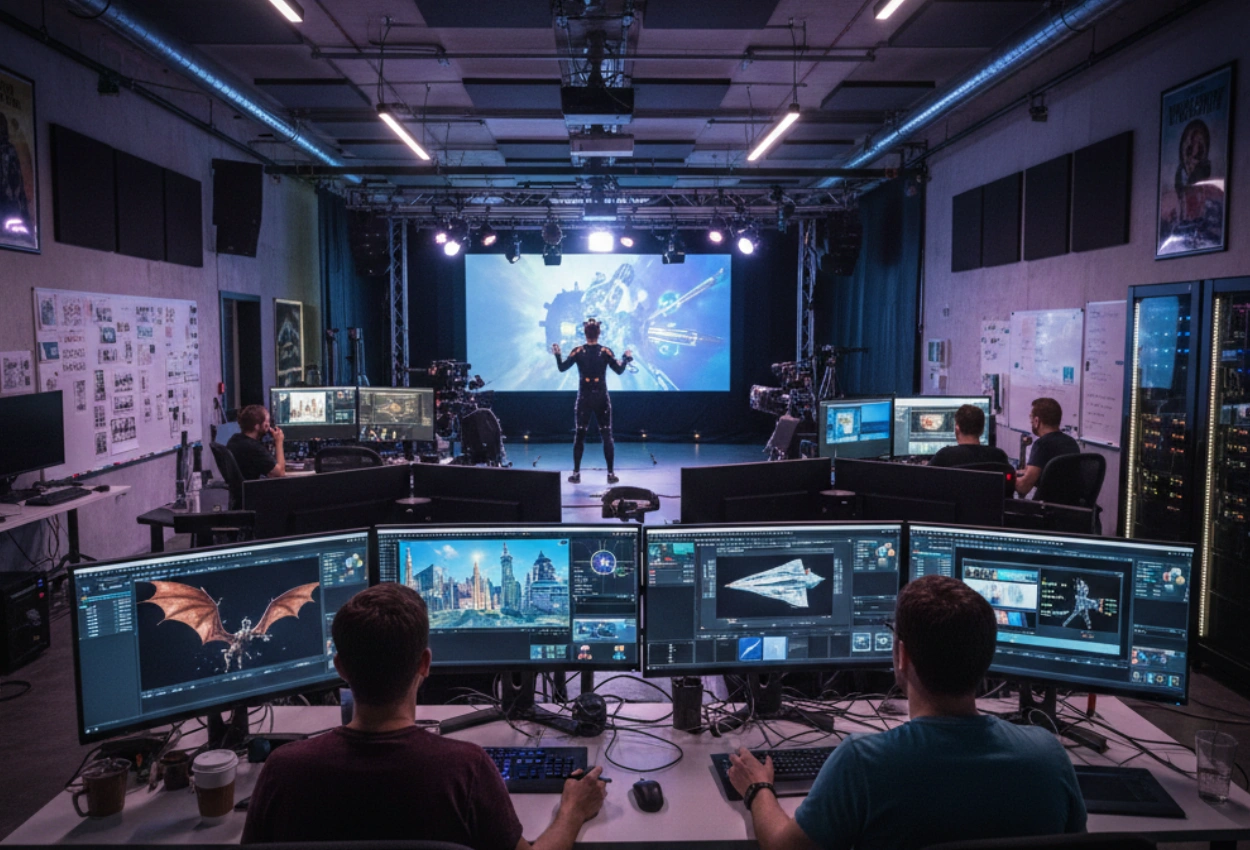
Inside a VFX Studio: How Visual Effects Companies Bring Stories to Life
The film is a process of imagining and envisioning your thoughts on the screen. The world you want to create needs effort and technology. Some moments can’t be captured due to the nature of fantasy and the ambition of your project. That is why, to complete your storytelling smoothly and precisely,Visual effects companies bring cinematic experience to life. A modern visual effects studio, Motion Effects, assists in creating the world of your vision, elevates the emotions, and completes the filmmaker’s vision by adding the required effects.
Visual Effects Studios Process in Three Acts
ACT 1.
Capturing the Foundation
The process of filming required another level of effort. Every story with VFX starts on set. One needs to take care of the vision while shooting the film. Scenes are filmed, actors perform, and cameras roll, but what you see on set is frequently not complete.
A blank green screen replaces a futuristic city. An alien planet is represented by a plain warehouse. Actors respond to things that won’t exist until later. Filmmakers and visual effects studio must work together in this situation.
This footage is referred to as the “plate.” It serves as the cornerstone upon which everything else will be constructed. But that foundation needs to be technically accurate to function. A smooth VFX process depends on factors, including consistent exposure, clean lighting, appropriate camera tracking markers, and precise lens data.
During this phase, filmmakers are frequently assisted by a seasoned visual effects company, which offers guidance on green screen setup, lighting direction, and camera angles. Because what can be recorded today dictates what can be recorded tomorrow.
At this point, the film does not look particularly impressive. But it has potential.
ACT 2.
Where VFX Begins
It is the time when all the imagination and raw footage come to the editing table. After filming is finished, the footage moves into post-production, where the actual change inside a visual effects studio starts.
Compositing preparation is the first step. After cleaning up the video and removing tracking markers, editors start using rotoscoping and chroma keying to isolate subjects. At this point, characters are cut off from their natural surroundings, and green screens vanish.
Motion tracking and match moving follow. The camera movement is examined for digital elements to flow organically with the scene. Visuals feel disjointed without this step. They feel authentic with it.
The world’s actual creation then starts. Motions Effect’s artists create 3D environments, create CGI elements, mimic natural effects, and carefully light these elements to replicate the original footage. This is the point where creativity begins to take shape.
Perspective, color, and depth are constantly changed. Every highlight, shadow, and reflection is taken into account. Even when everything is produced digitally, a talented visual effects company ensures that nothing appears fake.
At this point, the film begins to evolve. It is no longer raw footage. But it’s not finished yet.
ACT 3.
Where Everything Comes Together
As the process progresses, the movie starts to feel complete. Compositing becomes fluid. The environment and the subject are starting to merge into one cohesive image.
Motion Effects’ VFX artists use color grading to set the film’s mood. You can have a mood according to the script, like vibrant and surreal, dark and intense, or warm and romantic. All visual components are united into a single cinematic language in this step.
The final modifications are made. The editor ensures that edges are softened, lighting is balanced, and depth is enhanced. The goal is to create a virtual reality where the audience will never question what is real or what is created.
Here’s where visual effects companies really come into their own. Their labor is rendered invisible. The audience experiences the story rather than witnessing the effort.
What began as raw footage and a green screen abruptly transforms into a living, breathing world.
Climax.
More Than Effects, It’s Storytelling
A top-notch VFX studio supports narrative as well as producing images. To convince the viewer, every action, from the first frame to the last, is driven by the same objective.
Motion Effects are now creative partners as well as post-production teams. It helps independent filmmakers to dream big, shoot intelligently, and finish their projects.
Because adding visual effects is about how you make people feel.
FAQs
1. What do VFX companies actually do?
Visual effects companies produce and improve visuals using CGI, compositing, motion tracking, and simulations, to transform video into cinematic scenes that enhance narrative.
2. What happens inside a VFX studio after filming is complete?
Visual effects studio artists perform post-production tasks like
- Rotoscoping
- Green screen removal
- 3D modeling
- Compositing
- Color matching
to create the final visual environment.
3. How do VFX studios make CGI frames realistic?
We match lighting, shadows, camera movement, depth, and color grading with the original footage. It ensures that CGI elements blend with real-world scenes.
4. Do filmmakers plan for VFX before shooting?
Yes,visual effects companies work together during pre-production. It helps filmmakers with camera setup, setting up lights, and using a green screen.
5. How VFX company work with a video editing team?
They can work together in post-production, but their roles are different.
Cutting footage, pacing, and storytelling is video editor’s department.
VFX companies create and integrate visual elements like CGI and environments.